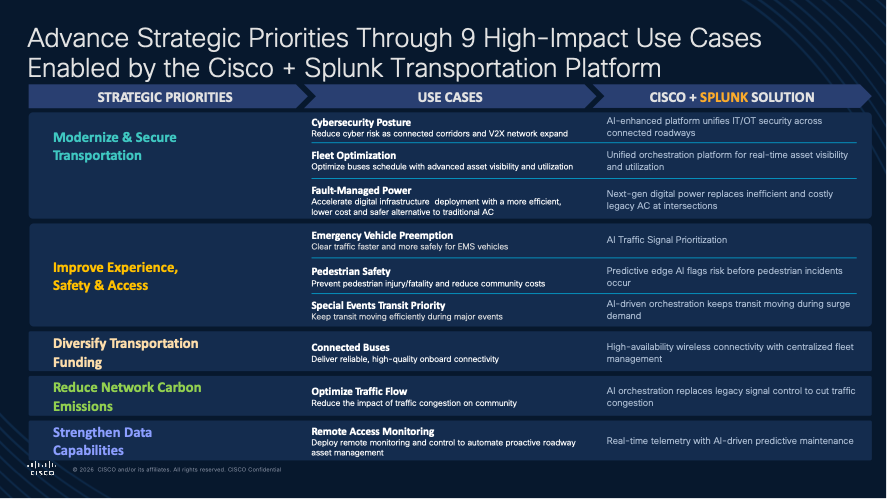
Urban Transportation Modernization Strategy – High Impact Use Cases
The Urban Transportation Modernization Strategy’s five strategic priorities can deliver measurable outcomesthrough a set of concrete, deployable business use cases. Nine high-impact use cases (See Figure x.x) enabled by Cisco’s Connected Roadways k, show how agencies can put these priorities into action and build a more modern urban transportation network.
1
Modernize and Secure Transportation Infrastructure. Protect connected transportation environments from AI-enabled cyberattacks while replacing aging infrastructure and legacy systems and aligning the workforce to manage this new, modern infrastructure. Modern, secure technology can help agencies protect connected IT and OT environments, reduce operating costs, and establish the foundation for secure, AI-enabled solutions.
2
Enhance User Experience, Safety, and Access. Improve public safety and reduce congestion hotspots while making public transit more responsive to the needs of residents. Focus service improvements on creating safer, more accessible transportation and extending reliable service across communities.
3
Diversify Transportation Funding Models. Develop new revenue streams to replace/supplementtraditional funding sources facing shortfalls, including fuel tax revenue. Programs such as smart parking, EV registration fees, and public-private partnerships can help agencies build a more resilient funding base for transportation investments.
4
Reduce Carbon Emissions Across the Network. Advance climate resilience and sustainability goals by making emissions reduction a core objective of transportation network modernization rather than treating it as a separate initiative.
5
Strengthen Data Capabilities. Build the AI skills transportation workforces need while making data secure, accessible, and easier to use—two capabilities essential to deploy AI-driven solutions effectively. Data underpins every strategic priority, from preventing cyberattacks and optimizing traffic flow to improving network efficiency and advancing sustainability goals. Strengthening these capabilities provides a foundation for modernization across the transportation network.
Three use cases address the infrastructure, security, and operational demands of modernization.
-
Enhance Cybersecurity Posture uses an AI-enhanced platform to unify IT and OT security across connected roadways, reducing risk as connected corridors and vehicle-to-everything (V2X) networks expand.
-
Fleet Optimization applies a unified orchestration platform to provide agencies with real-time visibility into asset utilization, improving bus scheduling.
Fault-Managed Power replaces inefficient, costly legacy AC systems at intersections with next-generation digital power to reduce deployment costs, accelerate installation, and improve safety.
-
Three use cases focus on moving people through urban transportation networks more safely and efficiently.
-
Emergency Vehicle Preemption uses AI-driven traffic signal prioritization to help EMS vehicles move through traffic faster and safer.
-
Pedestrian Safety applies predictive edge AI to identify risk before incidents occur, helping prevent injuries and fatalities and reduce their associated community costs.
-
Special Events Transit Priority uses AI-driven orchestration to keep public transit moving efficiently during periods of surge demand.
-
Connected Buses provide reliable, high-quality onboard connectivity through high-availability wireless connections and centralized fleet management. That connectivity can also create opportunities for new revenue-generating services.
Optimize Traffic Flow uses AI-driven orchestration to replace legacy signal control, reducing congestion and the associated transportation emissions.
Remote Access Monitoring combines real-time telemetry with AI-driven predictive maintenance to support proactive management of roadway assets.
Together, these nine use cases drive the Urban Transporation Modernization Strategy to deliver operational improvements and measurable business outcomes as detailed in Figure x.x. .
Figure 1. Urban Transportation Modernization Strategy’s Use Cases & Business Outcomes
Click or tap the image to expand.